This month, July 2012, I'm hosting The Accretionary Wedge, and the topic that I've chosen is "Geoscience & Technology". There is no question that technology has played an enormous role in the furthering of geoscience, and I'd like to assemble a series of posts from the geoblogosphere that describes the relationship. So, fellow geobloggers, how do you perceive technology impacting the work you do?
What to blog about?
I can think of a number of different directions that this topic can go. For example, if you're a geophysicist, you might discuss how some of the equipment you use works. If you're a geochemist, maybe you would like to explain how your fancy new ICP-MS measures those super cool isotope ratios. Maybe you'd like to post about GIS, GPS, Google Earth, or mobile technology. An epic post on how GPS receivers use billion dollar satellites to determine spatial location would be a welcome addition. Someone could use this opportunity to give some press to their favorite istuffs or Android apps. Perhaps you could highlight how a technological development in the past lead to new data that were not previously possible. Maybe someone will go uber-meta and post about the technology of social media and it's importance to the future of geoscience (any takers?). Whatever it is, feel free to discuss how you see technology making an impact on geoscience. Let's put together a great collection of posts!
How this works (mainly for new folks!):
The Accretionary Wedge is a geology blog carnival; in other words, about once a month a topic is sent out (like this post) and geobloggers write up their contribution to the topic at hand on their blogs. Anyone in geoscience is welcome to participate. Especially if you've never contributed before to geoscience blogging, don't be afraid to dip in a toe and test out the waters. You're welcome to join and add your voice to this conversation. The deadline for this event is the end of the month, July 31, 2012. Before that deadline, write up your post & publish it on your blog - start up a blog if necessary! :-). I recommend including references & links to The Accretionary Wedge blog and this Call for Posts. Not sure how your post will fit in? It's called the "Accretionary Wedge" for a reason! All rock types are allowed in this rock garden. Sometime in August, I'll read through all of the posts (that I know about!), write up a summary, and post it here on my blog. In other words, I need to know about your post, so please leave a link to your post in the comments below. You can also tag me in a post on Google+ or mention me in a tweet (@EarthlikePlanet) if you post a link to your contribution on those social networks (but the more that post links here, the easier it will be on me to corral them all). Let's go with hashtag #AW48. As to the deadline: if I haven't posted the summary blog post yet, then you might consider the deadline as more of a "guideline". Questions?

Geoscience news & issues on planet Earth, as well as anything else geological I feel like yabbering about.
Showing posts with label Accretionary Wedge. Show all posts
Showing posts with label Accretionary Wedge. Show all posts
Tuesday, July 10, 2012

Monday, January 30, 2012
Accretionary Wedge #42: Countertop Geology
This time around it's volcanoclast sending out the call for posts for this round of the Accretionary Wedge, asking geobloggers about countertop geology. Because pretty much everyone knows that the best countertops in a kitchen or bathroom are made of granite... or are they?
Although natural stone as countertop or tile is sold as either "granite" or "marble", they are often neither of those. The divisions "granite" and "marble" generally mean two kinds, the first being hard countertops made of silicate minerals and softer ones made of carbonate minerals. The term 'granite' is applied very loosely!
And that's the case with mine. A few years ago, my wife and I bought a house and the kitchen needed a total gutting. So before we moved in, we spent about a month tearing out the old kitchen and building the new one. While searching for something to use as a countertop, we came across a pile of "granite" tiles that I HAD TO HAVE. The stone was a black & white gneiss, a metamorphic rock. They were on a deep discount so we took home enough to cover the area we had planned for the counter. I then got to cut the tiles with a tile saw to fit, glued them down to the base we had built, and filled it in with grout. Cutting the stone tiles was good fun, of course!
The gneiss had large white feldspar clasts and tiny little folds in the foliation, and consequently was loaded with shear sense indicators - and yes, I did have them all going the same direction :-). I had my students in structural geology over a time or two for "lab" where they had to find & sketch some of them... and then we made home-made ice cream... you know, for the thermodynamics lesson about enthalpy with mixtures of ice & halite, or something...
We sold that house and moved to another a couple years back, and unfortunately we lost a lot of pictures that I had taken of the countertop. But, fortunately, some of the pictures of the kids had been backed-up, and I managed to find one of B that shows the countertop in the background. So if you can manage to look past this adorable blue-eyed blondie who doesn't have all her teeth yet, you'll see the gneiss in the background.

And here's a cropped, zoomed in version.

Although natural stone as countertop or tile is sold as either "granite" or "marble", they are often neither of those. The divisions "granite" and "marble" generally mean two kinds, the first being hard countertops made of silicate minerals and softer ones made of carbonate minerals. The term 'granite' is applied very loosely!
And that's the case with mine. A few years ago, my wife and I bought a house and the kitchen needed a total gutting. So before we moved in, we spent about a month tearing out the old kitchen and building the new one. While searching for something to use as a countertop, we came across a pile of "granite" tiles that I HAD TO HAVE. The stone was a black & white gneiss, a metamorphic rock. They were on a deep discount so we took home enough to cover the area we had planned for the counter. I then got to cut the tiles with a tile saw to fit, glued them down to the base we had built, and filled it in with grout. Cutting the stone tiles was good fun, of course!
The gneiss had large white feldspar clasts and tiny little folds in the foliation, and consequently was loaded with shear sense indicators - and yes, I did have them all going the same direction :-). I had my students in structural geology over a time or two for "lab" where they had to find & sketch some of them... and then we made home-made ice cream... you know, for the thermodynamics lesson about enthalpy with mixtures of ice & halite, or something...
We sold that house and moved to another a couple years back, and unfortunately we lost a lot of pictures that I had taken of the countertop. But, fortunately, some of the pictures of the kids had been backed-up, and I managed to find one of B that shows the countertop in the background. So if you can manage to look past this adorable blue-eyed blondie who doesn't have all her teeth yet, you'll see the gneiss in the background.

And here's a cropped, zoomed in version.

Monday, January 9, 2012
Accretionary Wedge #41: Most Memorable Geologic Event I've Directly Experienced: The Eruption of Mt. St. Helens
In the latest call for posts for the Accretionary Wedge, Ron Schott asked geoscience bloggers to relate "the story of the most memorable or significant geologic event that you've directly experienced".
For me that's easy, and yet also difficult. Easy because there's really only one significant geologic event that I've directly experienced that I'd call memorable & significant, but difficult because I had just turned 6 years old and don't recall a lot of it.
On the 18th day of the month of May, 1980, the lower 48 states of the U.S. experienced the eruption of Mt. St. Helens. Obviously when the mountain starts shakin' in a serious way, you don't live to tell about it from up close. Over 50 people died from the eruption, including one USGS geologist David Johnston who was monitoring the volcano at the time. He sent word via radio just as the eruption began "This is it!", and gave his life in the study of this mountain. I lived about 100 miles north of the volcano in a small town called Bremerton, WA. I don't recall a whole lot about the event, but I do remember watching some of the news reports on TV. Reports showed video of the ash-clogged & log-jammed streams, snow plows being used to remove the ash from roads, and pictures of entire forests flattened in one direction like matchsticks. It was amazing.

The mountain had been building up prior to this, with a large bulge on the north flank. The catastrophic blast of the mountain that day occurred after the bulge over-steepened the hillside and a huge landslide removed material down the mountain, lowering the pressure on the magma below and releasing the main blast. The blast mainly came out of one side of the summit, the north face of the mountain.
 The ash therefore mainly blew northward, but it didn't reach Bremerton. Instead, the winds took it eastward. So we never saw any ash where I lived, but one day after the blast my dad decided to drive south. He collected a small bottle of the ash, which has sat on my shelf for a number of years now and is pictured in these two photographs.
The experiences of geologists from the USGS and the University of Washington monitoring the mountain at the time are documented very well in a CNN video on youtube that unfortunately I can't embed here, but here's the link: http://www.youtube.com/watch?v=3XYfBxdVDJE The video is about 7 minutes long and well worth viewing to get a bigger idea of the impact of this eruption. Also for more info on the blast itself, check out this USGS eruption fact sheet.
For me that's easy, and yet also difficult. Easy because there's really only one significant geologic event that I've directly experienced that I'd call memorable & significant, but difficult because I had just turned 6 years old and don't recall a lot of it.
On the 18th day of the month of May, 1980, the lower 48 states of the U.S. experienced the eruption of Mt. St. Helens. Obviously when the mountain starts shakin' in a serious way, you don't live to tell about it from up close. Over 50 people died from the eruption, including one USGS geologist David Johnston who was monitoring the volcano at the time. He sent word via radio just as the eruption began "This is it!", and gave his life in the study of this mountain. I lived about 100 miles north of the volcano in a small town called Bremerton, WA. I don't recall a whole lot about the event, but I do remember watching some of the news reports on TV. Reports showed video of the ash-clogged & log-jammed streams, snow plows being used to remove the ash from roads, and pictures of entire forests flattened in one direction like matchsticks. It was amazing.

The mountain had been building up prior to this, with a large bulge on the north flank. The catastrophic blast of the mountain that day occurred after the bulge over-steepened the hillside and a huge landslide removed material down the mountain, lowering the pressure on the magma below and releasing the main blast. The blast mainly came out of one side of the summit, the north face of the mountain.

The experiences of geologists from the USGS and the University of Washington monitoring the mountain at the time are documented very well in a CNN video on youtube that unfortunately I can't embed here, but here's the link: http://www.youtube.com/watch?v=3XYfBxdVDJE The video is about 7 minutes long and well worth viewing to get a bigger idea of the impact of this eruption. Also for more info on the blast itself, check out this USGS eruption fact sheet.
Friday, September 30, 2011
Accretionary Wedge #38: Back to School: What Teaching Has Taught Me About Learning.
In the Call for Posts to this latest edition of the Accretionary Wedge, Anne asked:
"What should you and I and other geosciences profs be doing better?"
In graduate school, I took some really sweet courses - like Igneous Petrogenesis from Calvin Miller (at Vanderbilt), and later Tectonics from Rob Van der Voo and Metamorphic Petrology from Eric Essene (both at Michigan). These courses were fun and memorable, challenging yet enjoyable, and above all, made me think critically about the topics at hand. There were a number of others too.
And then there were the OK ones, the so-so ones, and the awful ones, and I won't name names. I knew I wanted to be a professor when I got out, and I knew, as everyone does, that there are professors who are good teachers, and there are those who are in-between, and there are those who need to be encouraged to find another profession. And I would be one of the good ones, right?
I'm in my 8th year as a professor now since leaving UM. The one thing I've learned clearer than anything, is that graduate school does not prepare one to be a good instructor. At all. I realize now how very little I knew about how people learn. Spiraling? Student Learning Outcomes? Scaffolding? Pedagogy? Bloom's Taxonomy? Cognitive, affective, and psychomotor domains? Assessment? Goals and objectives? I hadn't really heard of any of those terms. I was in training to become a professor, a job that at least in part involves teaching, but I hadn't even heard words of the language spoken by those who understand the literature on how to teach well. Graduate school does not prepare faculty to be good teachers, at least not intentionally.
In my early years as a professor, I absolutely couldn't understand why some of my students struggled so much to learn. Because I did some things really well. A lecture, now that I can deliver, with schnazzy, well organized powerpoint slides, numerous examples, interesting sidenotes, a couple of breaks for questions & discussion, and even a joke or two that drew actual smiles.
But here's what every professor needs to know: of that fantastic 50 minute lecture you just gave, the one you spent 2 full days preparing, organizing, scanning your old field photographs for examples, sifting through textbooks to find the right figures, and all of that - of that 50 minutes where you deliver a great lecture, students might retain about 10 minutes.
10 minutes?!!? Are you kidding me?!??! Unfortunately, no. Now, most of us professor go "now wait a minute, I got a whole lot more out of lectures than that!" Yes, you did... and that's why, today, you're the professor. But unfortunately the research shows that most people do not learn well from lectures. That's something I never learned as a student. But in my role as a teacher, this point has become crystal clear - for most students, lecture is largely a waste of time, even the good ones!
One concept that has revolutionized my teaching for the better is the realization that if students don't actively use the information being communicated to them, they won't really assimilate it or retain it. I've seen it many times now in the past 7+ years - I'll give a good lecture, students will comment that they learned the material, and we both feel good about what went on in that time we spent learning new concepts - but then I give them some problems to solve, or an activity to do, and they suddenly have tons of questions! They may have thought they understood a concept, but now having to apply it they realize they don't get it like they thought. Questions they didn't know to ask, now start coming out. These are the moments when they are really learning! All of us learn through our experiences, experiences that require us to overcome something, solve something, find a new way around something, etc. No one learns to ride a bike by sitting and listening to someone talk about how to ride a bike. You learn to ride a bike by getting up on that bike and trying to ride it - and you fail the first few times, maybe the first hundred times, but eventually, the neurons start to fire together in the right way, the skills are honed, and off you go!
So professors out there, if your students are struggling, even though you've given them what they need to know in a great lecture, and they've got some good books to help them out, and you went over that concept in class 5-6 times, and they asked questions, and it seemed to go really well, realize this - lecture is largely a waste of time. Man, I hate to say it! Partly because I've listened to some really great lectures at times, and really gotten a lot out of them. Instead, or rather in addition, think about what activities you could have them do, what problems you can give them to try and solve, and whatever else you can do to stop being the sage on the stage and start being the guide on the side. Because the good thing is, the students still need you. Student-centered learning doesn't mean that the teacher isn't important, far from it! Figured out a great way to talk about a tough concept? Got a great slide to summarize some complicated processes? Great! Deliver it well! Good lectures are still better than bad ones! But after that, what problems will you give them that will require them to use the information you just presented? What activities will you assign to them, where they apply the lessons learned?
When I first started teaching, this was really hard. What am I going to have them do? Do I have the materials I need? What questions will I ask? A really well developed activity takes a lot of work. To think about the learning goals of the activity, how to immerse the student in the subject, to assemble the right materials and equipment, and to write up a nice looking assignment sheet isn't an easy job. Fortunately, there is the Science Education Resource Center at Carleton College. For many years now, professors from all over have been contributing activities, labs, and other information to the site. I find that for me, the best way to use the site is to follow the Teach the Earth link, and then head to the "Upper Level Geoscience Courses" link, find the course I'm teaching, and start searching from there. There is a wealth of information there, but it isn't always easy to find what you need or what you're looking for even if you know it exists there. But a lot of the stuff submitted is pretty good, and with enough patience I can generally find something that at least sparks an idea in my head. Now that I've done it a few times, it has become much, much easier, to think about, create, and implement good activities, and student learning is increasing.
Teaching has taught me that even the best lecture is largely a waste of time, but working through activities, solving problems, and recreating experiments is time very well spent.
"What should you and I and other geosciences profs be doing better?"
In graduate school, I took some really sweet courses - like Igneous Petrogenesis from Calvin Miller (at Vanderbilt), and later Tectonics from Rob Van der Voo and Metamorphic Petrology from Eric Essene (both at Michigan). These courses were fun and memorable, challenging yet enjoyable, and above all, made me think critically about the topics at hand. There were a number of others too.
And then there were the OK ones, the so-so ones, and the awful ones, and I won't name names. I knew I wanted to be a professor when I got out, and I knew, as everyone does, that there are professors who are good teachers, and there are those who are in-between, and there are those who need to be encouraged to find another profession. And I would be one of the good ones, right?
I'm in my 8th year as a professor now since leaving UM. The one thing I've learned clearer than anything, is that graduate school does not prepare one to be a good instructor. At all. I realize now how very little I knew about how people learn. Spiraling? Student Learning Outcomes? Scaffolding? Pedagogy? Bloom's Taxonomy? Cognitive, affective, and psychomotor domains? Assessment? Goals and objectives? I hadn't really heard of any of those terms. I was in training to become a professor, a job that at least in part involves teaching, but I hadn't even heard words of the language spoken by those who understand the literature on how to teach well. Graduate school does not prepare faculty to be good teachers, at least not intentionally.
In my early years as a professor, I absolutely couldn't understand why some of my students struggled so much to learn. Because I did some things really well. A lecture, now that I can deliver, with schnazzy, well organized powerpoint slides, numerous examples, interesting sidenotes, a couple of breaks for questions & discussion, and even a joke or two that drew actual smiles.
But here's what every professor needs to know: of that fantastic 50 minute lecture you just gave, the one you spent 2 full days preparing, organizing, scanning your old field photographs for examples, sifting through textbooks to find the right figures, and all of that - of that 50 minutes where you deliver a great lecture, students might retain about 10 minutes.
10 minutes?!!? Are you kidding me?!??! Unfortunately, no. Now, most of us professor go "now wait a minute, I got a whole lot more out of lectures than that!" Yes, you did... and that's why, today, you're the professor. But unfortunately the research shows that most people do not learn well from lectures. That's something I never learned as a student. But in my role as a teacher, this point has become crystal clear - for most students, lecture is largely a waste of time, even the good ones!
One concept that has revolutionized my teaching for the better is the realization that if students don't actively use the information being communicated to them, they won't really assimilate it or retain it. I've seen it many times now in the past 7+ years - I'll give a good lecture, students will comment that they learned the material, and we both feel good about what went on in that time we spent learning new concepts - but then I give them some problems to solve, or an activity to do, and they suddenly have tons of questions! They may have thought they understood a concept, but now having to apply it they realize they don't get it like they thought. Questions they didn't know to ask, now start coming out. These are the moments when they are really learning! All of us learn through our experiences, experiences that require us to overcome something, solve something, find a new way around something, etc. No one learns to ride a bike by sitting and listening to someone talk about how to ride a bike. You learn to ride a bike by getting up on that bike and trying to ride it - and you fail the first few times, maybe the first hundred times, but eventually, the neurons start to fire together in the right way, the skills are honed, and off you go!
So professors out there, if your students are struggling, even though you've given them what they need to know in a great lecture, and they've got some good books to help them out, and you went over that concept in class 5-6 times, and they asked questions, and it seemed to go really well, realize this - lecture is largely a waste of time. Man, I hate to say it! Partly because I've listened to some really great lectures at times, and really gotten a lot out of them. Instead, or rather in addition, think about what activities you could have them do, what problems you can give them to try and solve, and whatever else you can do to stop being the sage on the stage and start being the guide on the side. Because the good thing is, the students still need you. Student-centered learning doesn't mean that the teacher isn't important, far from it! Figured out a great way to talk about a tough concept? Got a great slide to summarize some complicated processes? Great! Deliver it well! Good lectures are still better than bad ones! But after that, what problems will you give them that will require them to use the information you just presented? What activities will you assign to them, where they apply the lessons learned?
When I first started teaching, this was really hard. What am I going to have them do? Do I have the materials I need? What questions will I ask? A really well developed activity takes a lot of work. To think about the learning goals of the activity, how to immerse the student in the subject, to assemble the right materials and equipment, and to write up a nice looking assignment sheet isn't an easy job. Fortunately, there is the Science Education Resource Center at Carleton College. For many years now, professors from all over have been contributing activities, labs, and other information to the site. I find that for me, the best way to use the site is to follow the Teach the Earth link, and then head to the "Upper Level Geoscience Courses" link, find the course I'm teaching, and start searching from there. There is a wealth of information there, but it isn't always easy to find what you need or what you're looking for even if you know it exists there. But a lot of the stuff submitted is pretty good, and with enough patience I can generally find something that at least sparks an idea in my head. Now that I've done it a few times, it has become much, much easier, to think about, create, and implement good activities, and student learning is increasing.
Teaching has taught me that even the best lecture is largely a waste of time, but working through activities, solving problems, and recreating experiments is time very well spent.
Friday, August 26, 2011
Accretionary Wedge #37: Sexy Geology: Bancroft, Ontario
For the first time in this blog, I've decided to join a host of other geobloggers in the geoblog carnival, which is aptly named The Accretionary Wedge. This time around, Lockwood at Outside the Interzone has called for posts around the topic "Sexy Geology", described as geology that makes you heart race and your pupils dilate.
In thinking about what to contribute many places came to mind, but in the end so many of them are found near a magical place called Bancroft, Ontario. Bancroft is a small town that is world renowned for its mineral specimens. It is the "Mineral Capital of Canada", due to the great allure of the area to rockhounds and mineral collectors, who are drawn there not only for the vast number of minerals that can be found but also the quality of specimens in size and shape. Of the ~4000 known minerals, at least 1600 are known in the Bancroft area, some sources have said the number is even higher.
There are way too many sites around Bancroft to really give a full account; I'll highlight just a few of my very favorites:
1) Egan Chutes Provincial Park at the York River:
This locality includes several stops on both sides of the York River-
The Goulding-Keane Nepheline Pegamtite Quarry (N 45° 04.201’, W 077° 43.947’) is an abandoned small quarry with easily seen large crystals of magmatic nepheline, biotite, calcite, sodalite, and zircon. The zircons are large enough to be seen in hand specimen! This quarry is the source of the large dump of crushed rock in the center of town (N 45° 03.432’, W 077° 51.379’), where rockhounds can pick through these rocks and take what they like.
Continuing down the trail from the G-K quarry, you'll reach the main chute, where the river pinches down at a terrific waterfall (N 45° 04.473’, W 077° 44.081’). The nepheline gneisses here also contain diopside, scapolite, hornblende, plagioclase, and at one point in time contained sapphire (but the larger samples have all been removed).
Heading back, across the York River from the G-K quarry mentioned above lies the York River Skarn (N 45° 04.210, W 077° 43.914’). The unaltered marble can be seen in a roadcut (N 45° 04.066’, W 077° 43.874’) just before the trail to get to the skarn, which is good to visit before seeing the skarn to truly appreciate the changes that took place in these rocks as the nepheline pegmatite intruded (and it has some spectacular sigma clasts). At the skarn, about 50 minerals have been described at this single outcrop, including garnet, diopside, wollastonite, vesuvianite, forsterite, clinohumite, spinel, clintonite (a green, Ca-mica), among many others.
2) MacDonald Mine:
This is an old uranium mine in a granite pegmatite (N 45° 09.928', W 077° 49.189'), dominated by GIANT K-feldspar & quartz crystals. Some of the K-spar crystals are ~10' long, and some quartz grains are the size of beach balls. Much of the quartz is dark & smokey, due to the presence of the uranium ore mineral, uranian pyrochlore ("ellsworthite"). The pyrochlore grains themselves are typically round & ~4 inches in diameter. And they are HOT. They will send your Geiger counter into awesome mode. Also present are andradite (black Fe+3-rich garnet), sphene, and zircon. As an American, it is really surprising to be able to freely enter a place like this; in the U.S. this mine would be surrounded by 20' tall fences, barbed wire, and very large guards with very large dogs and guns; the size of the KEEP OUT signs would reach epic proportions. But here in Bancroft, you can just park at N 45° 09.846’, W 077° 49.160’ and hike in.
3) Orange Calcite Roadcut:
Along Monck Road, a cut at the top of a small hill (N 45° 00.169’, W 078° 00.360’) displays some fascinating rocks with orange calcite and large grains of white tremolite. Several grains of a highly radioactive mineral I have yet to identify are present here, which are easily found with a Geiger counter as they set it on fire.
4) Green Mantle Farm Eco-Tour:
If you have the time, and really, you should make it, there is no substitute for taking a tour with Mark Bramham through his property and adjacent Crown land to see some truly fantastic mineral specimens in the wooded areas surrounding his home (N 45° 00.663', W 078° 14.903'). No sample collecting is allowed, but you won't regret going. Let me just say "fluororichterite stream". Richterite is an amphibole like tremolite, but substitute 2 Na+ for Ca+2, and the richterite here contains significant fluorine for the OH- group. There are very few places in the world where fluororichterite is known, so your choices for viewing it are limited.
You'll also see gorgeous GIANT euhedral hornblende, orthoclase, green apatite, and museum quality red clinohumite. The tour lasts 2.5-3 hours, and their playful dogs add to the charm of this wooded walk. Although he's sitting on a mineralogical gold mine, Mark's passion for conservation is inspiring. Besides the material found on his own property, He has used the mining law to stake a claim on the adjacent Crown land so that he could protect the minerals and keep them in their natural place for future generations to see.
So there you have it, my take on Sexy Geology, with a virtual visit to Bancroft, Ontario. And this is but a small slice of what is available in this area!
In thinking about what to contribute many places came to mind, but in the end so many of them are found near a magical place called Bancroft, Ontario. Bancroft is a small town that is world renowned for its mineral specimens. It is the "Mineral Capital of Canada", due to the great allure of the area to rockhounds and mineral collectors, who are drawn there not only for the vast number of minerals that can be found but also the quality of specimens in size and shape. Of the ~4000 known minerals, at least 1600 are known in the Bancroft area, some sources have said the number is even higher.
There are way too many sites around Bancroft to really give a full account; I'll highlight just a few of my very favorites:
1) Egan Chutes Provincial Park at the York River:
This locality includes several stops on both sides of the York River-
The Goulding-Keane Nepheline Pegamtite Quarry (N 45° 04.201’, W 077° 43.947’) is an abandoned small quarry with easily seen large crystals of magmatic nepheline, biotite, calcite, sodalite, and zircon. The zircons are large enough to be seen in hand specimen! This quarry is the source of the large dump of crushed rock in the center of town (N 45° 03.432’, W 077° 51.379’), where rockhounds can pick through these rocks and take what they like.
Continuing down the trail from the G-K quarry, you'll reach the main chute, where the river pinches down at a terrific waterfall (N 45° 04.473’, W 077° 44.081’). The nepheline gneisses here also contain diopside, scapolite, hornblende, plagioclase, and at one point in time contained sapphire (but the larger samples have all been removed).
 |
| Egan Chute Falls |
2) MacDonald Mine:
This is an old uranium mine in a granite pegmatite (N 45° 09.928', W 077° 49.189'), dominated by GIANT K-feldspar & quartz crystals. Some of the K-spar crystals are ~10' long, and some quartz grains are the size of beach balls. Much of the quartz is dark & smokey, due to the presence of the uranium ore mineral, uranian pyrochlore ("ellsworthite"). The pyrochlore grains themselves are typically round & ~4 inches in diameter. And they are HOT. They will send your Geiger counter into awesome mode. Also present are andradite (black Fe+3-rich garnet), sphene, and zircon. As an American, it is really surprising to be able to freely enter a place like this; in the U.S. this mine would be surrounded by 20' tall fences, barbed wire, and very large guards with very large dogs and guns; the size of the KEEP OUT signs would reach epic proportions. But here in Bancroft, you can just park at N 45° 09.846’, W 077° 49.160’ and hike in.
3) Orange Calcite Roadcut:
Along Monck Road, a cut at the top of a small hill (N 45° 00.169’, W 078° 00.360’) displays some fascinating rocks with orange calcite and large grains of white tremolite. Several grains of a highly radioactive mineral I have yet to identify are present here, which are easily found with a Geiger counter as they set it on fire.
 |
| orange calcite and large white fibers of tremolite |
4) Green Mantle Farm Eco-Tour:
If you have the time, and really, you should make it, there is no substitute for taking a tour with Mark Bramham through his property and adjacent Crown land to see some truly fantastic mineral specimens in the wooded areas surrounding his home (N 45° 00.663', W 078° 14.903'). No sample collecting is allowed, but you won't regret going. Let me just say "fluororichterite stream". Richterite is an amphibole like tremolite, but substitute 2 Na+ for Ca+2, and the richterite here contains significant fluorine for the OH- group. There are very few places in the world where fluororichterite is known, so your choices for viewing it are limited.
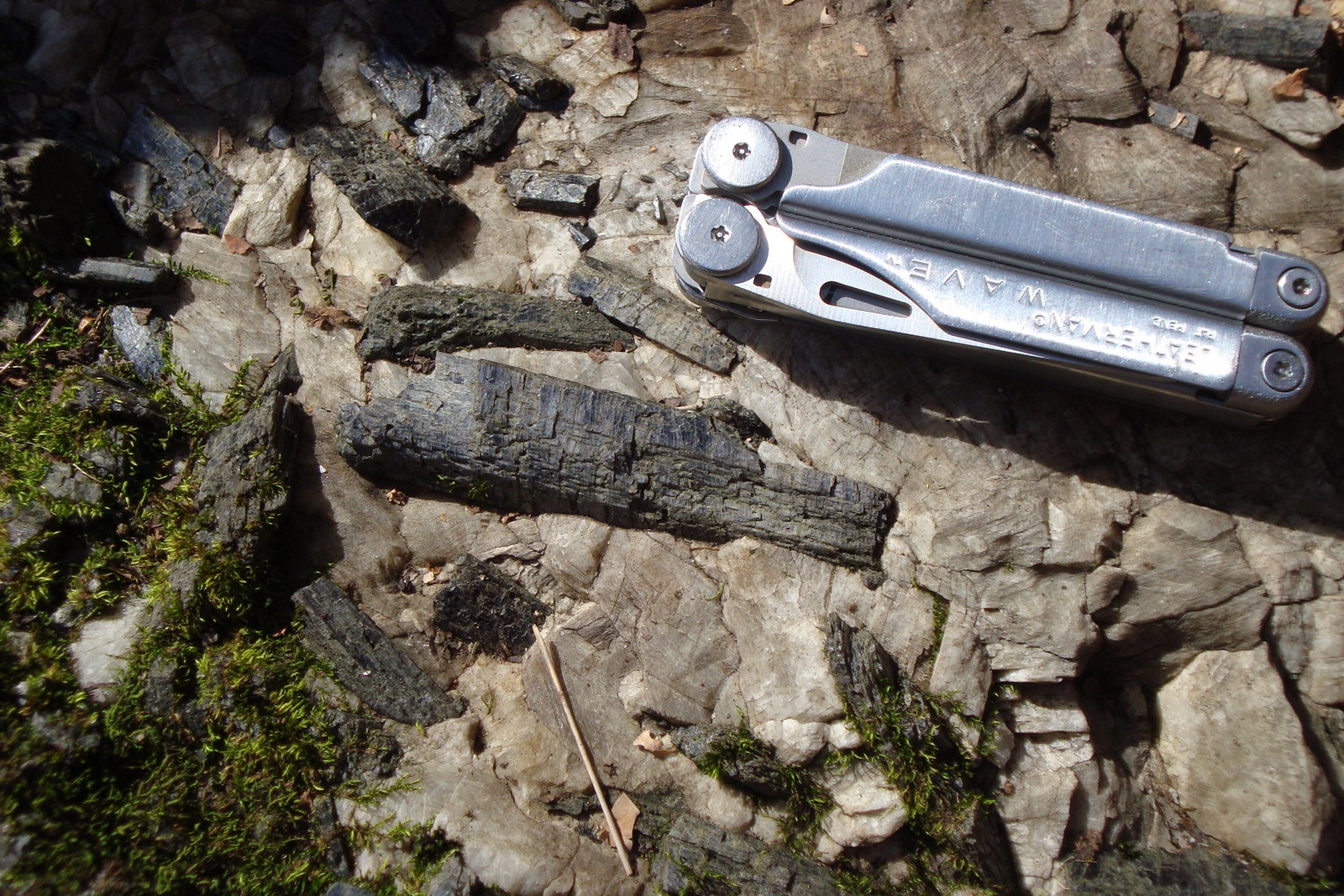 |
| Large dark green crystals of fluororichterite |
 |
| Euhedral hornblende crystals |
 |
| Euhedral orthoclase crystals |
So there you have it, my take on Sexy Geology, with a virtual visit to Bancroft, Ontario. And this is but a small slice of what is available in this area!
Subscribe to:
Posts (Atom)